
Announcing Immigration Daybook
A weekday rundown of the immigration system — and a calendar of what's coming. Proudly algorithmic, crafted with care. Free pilot all August.
August 3, 2026 · David Eads · Edited by Tory Lysik
Leer en español →Immigration Daybook is out every weekday.
Free August pilot · English and Spanish editions
On Aug. 24, the comment window closes on a DHS rule that would raise the naturalization filing fee by 75% and eliminate fee waivers outright. If you’re filing, that’s real money you have to budget for. If you’re a lawyer, that’s a week of phone calls you’d rather schedule than receive. If you’re a reporter, that’s a story you want to file on the 23rd, not the 25th.
Maybe you already knew, because you track this stuff yourself. A lot of people don’t, and shouldn’t have to.
That’s what we built Immigration Daybook to solve. Every weekday: a rundown of what happened in the immigration system, along with the part I’m most excited about — a calendar of everything we know that’s coming. Effective dates, comment deadlines, court dates, all backed by primary sources and links to expert analysis. The rules that quietly take force while everyone’s arguing about the outrage of the day.
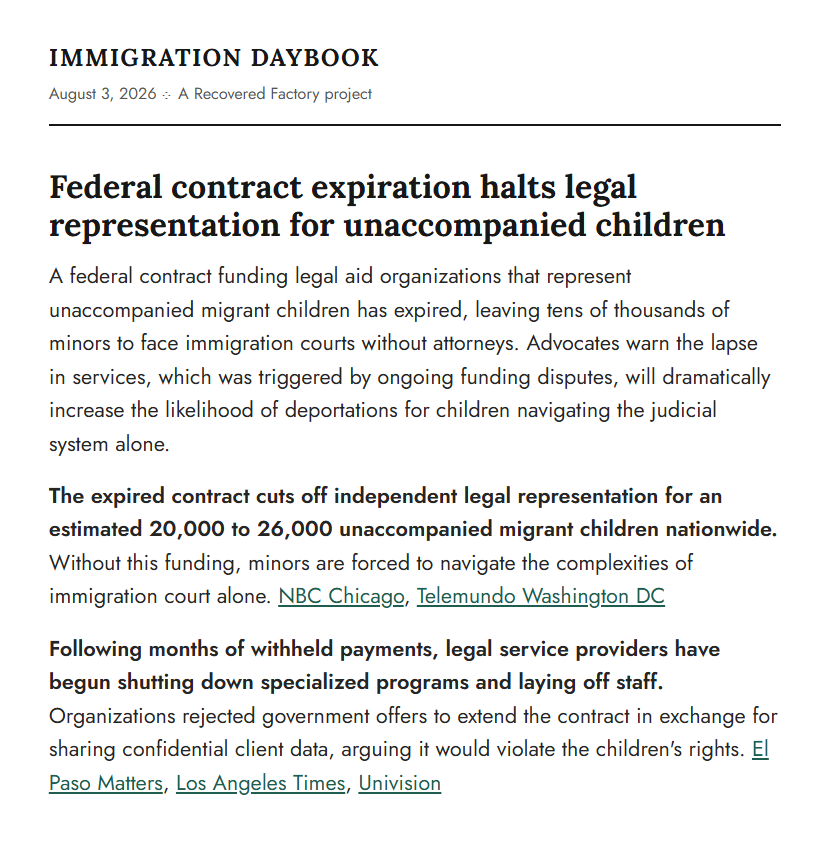
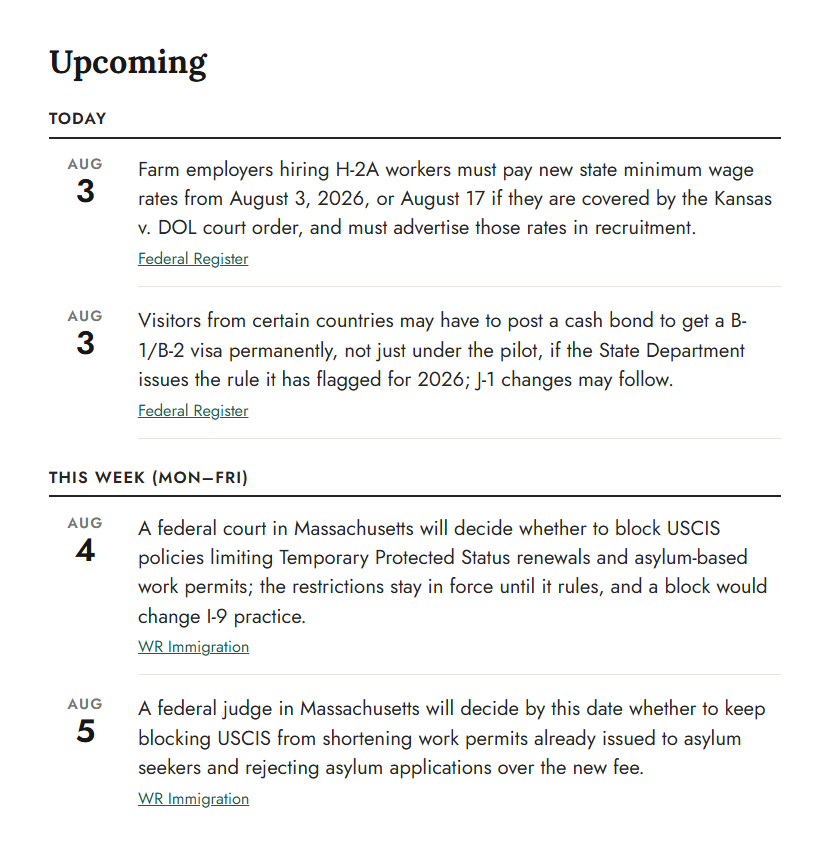
Finding the fire in the smoke
There’s a lot of metaphorical fire in the U.S. immigration system right now, but there’s even more smoke: thousands of articles, videos, threads, and posts a day, often trying to cover actions that seem designed to create confusion, chaos, and spectacle.
Machines are good at telling you where the smoke is thickest. Finding the fire takes judgment and expertise.
So this newsletter is proudly algorithmic, and we intend to make it the most carefully crafted algorithmic writing you’ve ever read. We go beyond the big stories and prestige investigations you probably already saw. Spanish language TV news, deeply technical policy blogs, Substack newsletters, social video — from nerdy law blogs to YouTube coverage of ICE raids, we’re watching and bringing you what’s relevant.
But the machine doesn’t get the last word, and it can’t do the part that matters most. The system reads the day’s news and surfaces the patterns it finds. Then I edit: what it means, whether it’s accurate, and who covered it best.
I’ve been on this beat a while. I was the de facto immigration editor at The Marshall Project for my first several years there, and my team did a lot of the lifting on their pop-up immigration newsletter last summer. So when we write about deportation and detention trends, we check the latest data from the Deportation Data Project and their analysis of data gaps. When we write about 287(g), we pull the roster and read the actual agreements. When we write about a rule or policy change, we look it up in the Federal Register and the USCIS Policy Manual first.
The newsroom brain
Our bet here isn’t “AI reads the news.” Lots of people are doing that, and the majority of it is slop. Our bet is that a newsroom can have a brain — something you can actually query about everything it knows, that shows its work instead of asking you to trust it.
We’re using a tool called PromptQL for that. Rather than handing a pile of documents to a chatbot and hoping its guesses are good, it writes an explicit plan that runs outside the language model, so we can read the steps, reproduce them, and check them. It drafts into a Google Doc, lets us know the draft is ready for edits, and finally picks the edited draft back up to produce the final newsletter.
We think tools like this are going to be a major part of how news gets made. Immigration Daybook is an experiment in how far that takes a small, scrappy shop like Recovered Factory.
The pilot
We’re running August as a pilot for free, while we figure out what this should be and how to sustain it. We’d rather have you in the room for the early version than polish it in a vacuum, so tell us what’s missing and what you’d actually use.
Sustainability is the open question. This runs on a fraction of what a traditional link newsletter takes, but it isn’t free: there’s real computing costs, plus the time we spent building the system and the time I’ll spend editing it every day. We’re not chasing philanthropic money — while we will accept it under some circumstances, we’d rather be accountable to our audience than to a program officer — which means at some point we sell something at a fair price that covers costs and pays for the work. This month is how we find out what that is.
Out every weekday.
Free through August · Unsubscribe anytime